
Against Alienation: Technologies That Draw Us Closer to Nature
My foray into the fertile world of digital nature tech

Hello and welcome to new subscribers. I write about technology’s impact on us humans and our beleaguered planet and I’m extremely grateful to all who read, share, or comment on The Egg. Please consider becoming a subscriber if you’re not one already. It’s free(!) and it really helps to support my work.
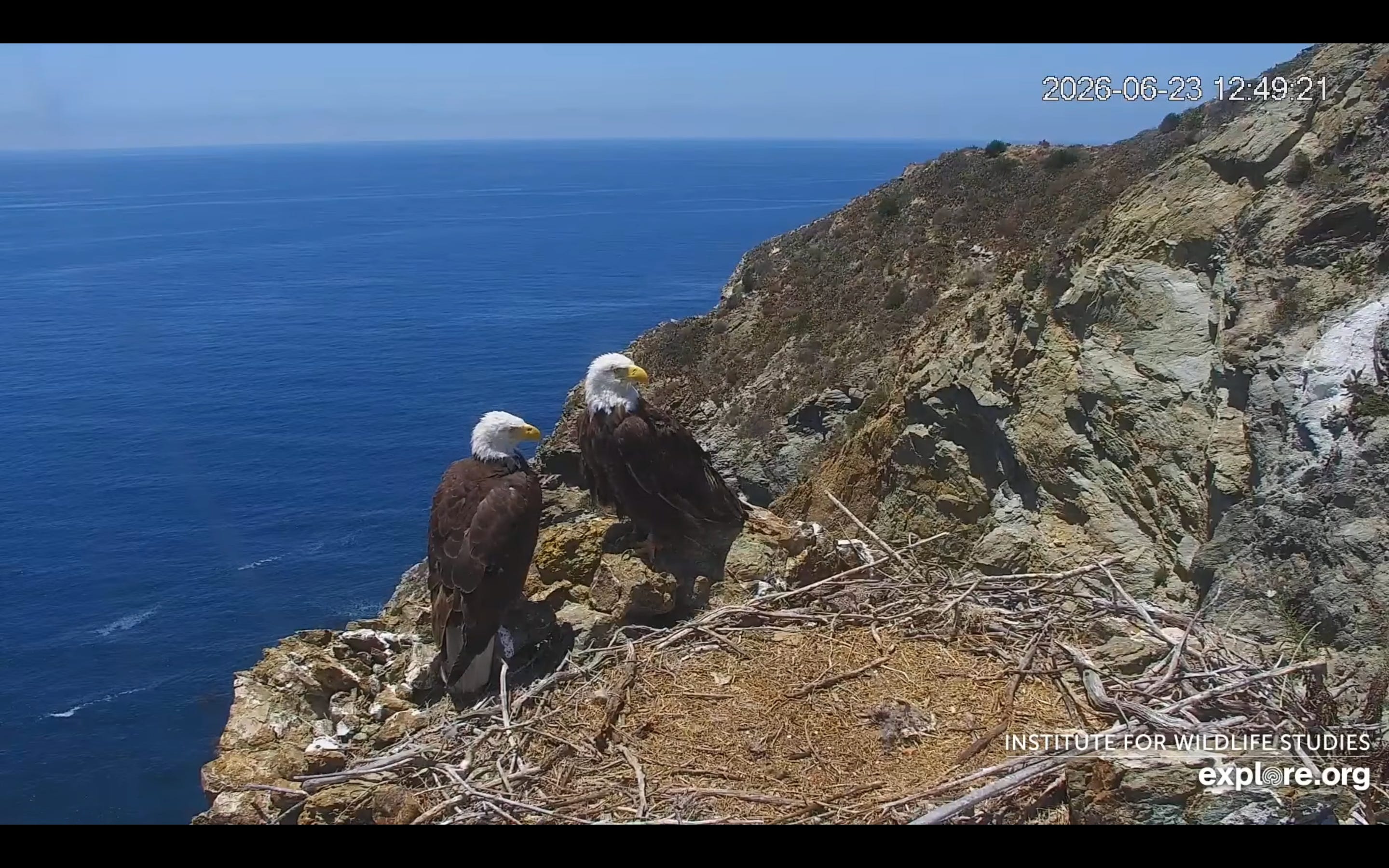
The idea that industrial society alienates humans from the natural world is well-trodden terrain. In Walden (1854), Henry David Thoreau lamented that “men have become the tools of their tools,” while his intellectual descendant, John Muir, would later observe that:
Thousands of tired, nerve-shaken, over-civilized people are beginning to find out that going to the mountains is going home…trying as best they can to mix and enrich their own little ongoings with those of Nature, and to get rid of rust and disease.1
I’m inclined to agree. In my day job I walk through laboratories containing some of the most advanced and impressive research technology,2 yet I never feel quite so at home as when I’m in the woods. But there doesn’t always have to be such a wide gulf between tech and trees. There are many technologies that not only do not alienate us from nature but draw us closer to it, leaving us humbled and changed for the better. Telescopes extend our eyes to distant galaxies. Microscopes reveal tiny worlds teeming with life. The hydrophone allows us to listen to whales; SCUBA allows us to swim alongside them.
But the telescope is over 400 years old and those other examples are not exactly new either. And they’re all analog; they all rely on direct physical inputs of light, sound, etc. Although I’m a fan of analog, I can’t help but wonder: What about digital technology? Are there any modern devices, smartphone applications, or even (dare I say) artificial intelligence systems that are actually “de-alienating,” that deepen our connection to the natural world rather than separate us further from it?
De-alienating Technology Defined
Possibly. But before trying to answer that question it’s first necessary to define what constitutes a legitimately de-alienating technology. I think it requires meeting four criteria:
1. It should act as an extension of our senses, or our bodies, in a way that encourages us to engage with nature. The microscope is a perfect example in that it extends our sense of vision into previously unseen parts of the natural world.
2. It should inspire feelings of discovery, wonder and (ideally) awe. Once again, the microscope is a great example (and if you don’t believe me, try to not be amazed while viewing the images of Nikon’s Small World Competition).
3. It should be benignly receptive. By this I mean it should take in data from the world without causing harm to the world. Removing a drop of pond water to study it under microscope does not harm the pond or its inhabitants (except, of course, for the poor microbes in the drop itself).
The fourth and final criterion is particularly relevant for digital technology and its inherent tendency to glue people’s eyeballs to their screens:
4. It should encourage people to actually get outdoors and directly experience nature rather than engage with mere representations of nature. Rounding out my quintessential microscope example, you can’t get that drop of pond water without visiting an actual pond.
Some Possible Examples
Thus armed with my search criteria, here’s what I found while venturing around our modern digital landscape:
Merlin Bird ID
If this search was a popularity contest, Merlin Bird ID, a smartphone app with over 10 million active users (myself included), would likely be the winner. Merlin is basically Shazam for birds in that it identifies birdsongs. However, its maker (Cornell Lab) points out that that’s not really a fair comparison because Merlin’s job is much harder. It identifies multiple species at the same time and does so while accounting for regional differences and filtering out other background sounds.
The tech behind it (spectrogram image processing) relies on machine learning and is quite fascinating but the point here is to assess how well the app helps connect people with the wild. While it doesn’t necessarily increase appreciation for birdsong (hopefully you have that already) it can increase one’s sensitivity to it. I noticed while using it, for example, that it picks up even the faintest songs, calls, and chirps—sounds I would otherwise miss—and then it also identifies the bird making them. It’s also helped me quietly discover local avian diversity and habitat. Taken together, this all means it meets my first three criteria.
But since it relies on a smartphone, it does seem to rub up against criterion #4 (the one about encouraging people to experience nature rather than stare at a screen) and so the question becomes: Does the app direct my attention more toward the birds or toward my phone?
It depends. When I have Merlin open, the answer is usually my phone. But a curious thing happened after using the app over several months. I began to notice that, while common birds like robins, blue jays, and cardinals dominate my backyard chorus, there are also less-frequent visitors like tufted titmouse and song sparrow, and there have even been cameo appearances by species like the northern mockingbird and eastern screech-owl. I’ve also come to better appreciate the rich variation in their songs, everything from pleasantly melodic (robins) to spooky (screech-owl).
The effect has been to draw me closer to nature by stirring a hitherto unknown interest in birding. As such, the app does seem to pass muster as de-alienating tech.
Echo Meter Touch 2
If Merlin is Shazam for birds, then Echo Meter Touch 2 (EMT2) is Shazam for bats, even if its species ID is not as accurate as Merlin’s because bats use ultrasonic echolocation that’s not as distinctive as bird sounds.
Like Merlin, however, the technology behind it is fascinating. It relies on an ultrasonic microphone that attaches to a smartphone or tablet that captures and digitizes what are the otherwise inaudible bat calls. Thus, it scores very high on criterion #1 (extends our senses) in that it “hears” sounds that we can’t. It also scores high on criterion #2 (increases discovery and sense of wonder) in that it converts those sounds into audible variations that nonetheless retain the same acoustic qualities.
Unfortunately, it’s not as affordable as Merlin. The EMT2 retails at $179 and I can’t say I’ve tried it myself. But it’s not hard to imagine that it meets the other criteria too—it does no harm to bats (criterion #3) and also inspires people to take nocturnal wanderings outside (criterion #4)—so I think it clearly counts as a de-alienating technology.
Other Apps
There are other nature apps to consider as well and, like Merlin and EMT2, many are similarly focused on identification.
In the realm of plant identifiers, the popular PictureThis app does a decent job identifying plant species based on one good photo. A recent study found it was 88% correct at the genus level and 76% correct at the species level making it the most accurate of all apps tested (including AI chatbots). It also provides evaluations of plant health, suggestions on care, etc., so it’s an excellent source for gardeners.
Then there are the social media nature apps. Pl@ntNet, for example, connects users to a global network of amateur-to-professional botanists with daily active users numbering in the hundreds-of-thousands. Users upload pictures of any plant organ (leaves, stems, etc.) to be identified by both AI and other users. iNaturalist is similar, except that it covers virtually every macroscopic living organism. Both apps make legitimate contributions to the natural sciences by providing a continually updated, global database of biodiversity (iNaturalist boasts that its data has been cited in over 7,000 academic papers so far).
But both are also social media apps requiring significant screentime and, as such, I was initially inclined to dismiss them as failing criterion #4. But after spending some time on the platforms I realized that was probably unfair. Their users seem focused not only on advancing botany and zoology but a general love of plants and animals as well—and they obviously spend a lot of time outdoors. So, while the idea of “nature-friendly social media apps” still seems paradoxical, I think it’s fair to consider them as de-alienating.
Nature Cams and Camera Traps
And then there are nature cams and camera traps, surreptitiously placed digital cameras recording animals in their natural habitat. Cams record for extended periods and are typically publicly viewable on the internet. Traps only turn on when an animal arrives or is active in the viewing area. Their scientific value is unquestionable, but I’m more interested in whether they elevate the human spirit by drawing us closer to our fellow creatures. After all, they obviously tie the user to a screen without prompting the user to get outdoors. Doesn’t this just make them another form of digital distraction, another drop in the floodwaters of online content?
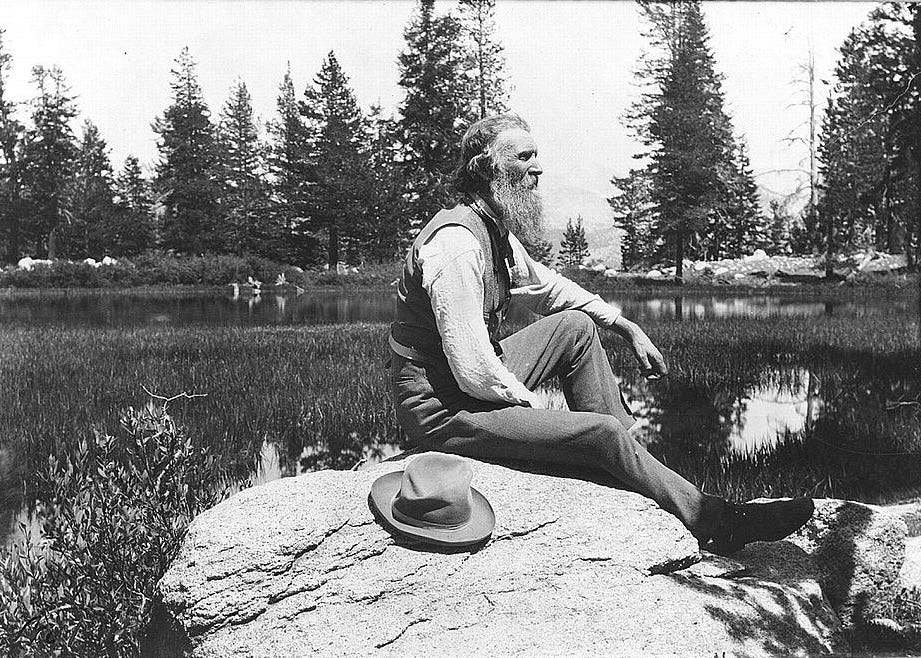
I thought so until I spent some time actually monitoring several of them. I watched bears lumbering by a river, fish swimming around a coral reef, eagles perched on high cliffs. The feeds were surprisingly engaging. Night-vision allowed them to transmit during the quiet hours (which allowed me to witness a bald eagle waking from its slumber). Their cameras occasionally panned and zoomed, a pleasant surprise. And (except for the ones underwater) they all came with sound, like the sound of wind or water, or the cries of eagles.
I found it all quite soothing and meditative, which was a bit of a surprise. After all, my premise was that we had to actually go outside and be in nature to experience its benefits, to “enrich our own little ongoings” as John Muir would put it. Could my soul be similarly enriched by simply watching nature from my desk?
Social Science and Common Sense
As it turns out, the answer is “yes” and social scientists have been documenting it for decades. Here’s a representative sampling of studies on it:
In a famous 1984 study, surgical patients recovering in rooms with windows looking out onto a natural scene had shorter postoperative hospital stays, took fewer painkillers, and generally recovered better than comparable patients in rooms with windows facing a brick wall.
A 2013 study found that simply viewing pictures of nature aided cardiovascular recovery from stress.
A 2021 study of over 140,000 social media comments concluded that people who watched nature videos (including livestreams) during the COVID-19 lockdowns experienced increases to their overall mental well-being.
A 2025 study of hospitalized psychiatric patients found that short-term immersion in virtual-reality nature settings increased patients’ connectedness to nature and significantly reduced their perceived stress, depression, and anxiety levels.
So I guess I shouldn’t have been so surprised by the effect of the live feeds on my psyche. Perhaps I need to lighten up a little on my criterion #4? If so, even live feeds would make the cut as de-alienating technology. Then again, there are limits to what the research actually shows. Other studies have found that, while digital nature can help mitigate stress or attenuate a sour mood, only real nature significantly boosts one’s mental and physical well-being.
Which sort of strikes me as common sense. After all, no app, no image, no internet feed can truly substitute for the real thing. So while I appreciate nature tech and even use some of it myself, there is nothing quite like seeing actual sunlight sparkling through a forest canopy, or finding your footing on uneven rocks, or smelling the sweet dampness of leaves and earth…to give you the feeling of going home.
John Muir, The National Parks (1901)
I’m a space and resource manager at a biomedical research institute in Philadelphia.